Product Design
CafeCo
A café ordering app built in three months, from pandemic idea to working prototype
Role
Product Designer & Co-creator
Timeline
2022
Team
2 product designers
Client
Personal project
2020 hit everyone hard, and adjusting to the new "normal" took a while. One of the things my friends and I missed most was going to our favorite coffee shops and restaurants to enjoy a quality drink, especially coffee. Since ordering hot drinks online wasn't really an option, we started thinking about how we could make it work during the pandemic.
Even as life gradually returns to normal, we believe the concept behind this case study remains relevant. For people with busy schedules, the ability to skip the line using our app is still a big win.
My Role
As a Product Designer and co-creator of the app, I helped shape the overall concept, define the product journey, and design the prototype and visual identity.
I worked closely with my teammate to brainstorm and refine ideas based on solid UX and startup principles: understanding future users, identifying client needs, and building with purpose.
Over the span of three months, we dedicated 2–3 hours each week to the lo-fi prototype and visual design. Since it was a two-person effort with a hackathon-style approach, the documentation is minimal, just the essentials.
The Context
This idea came out of one of those late-night conversations about gadgets that could make everyday life easier. Naturally, during the pandemic, most ideas circled around "I want fewer people around me" or "I miss my favorite spots!"
Supporting Local Businesses. We also saw a chance to help struggling local cafés by giving them better tools to manage customer orders and workflow efficiently.
Order. Grab. Enjoy. Given the pandemic's limitations, we knew we had to minimize in-person interaction. So we designed the app to let users set all their preferences ahead of time.
Stay in the Loop. User interactions are centered around upcoming orders. A few minutes before pickup, both customer and café staff receive instructions tailored to their needs.
Design Challenges
There are tons of food delivery apps out there, but few focus specifically on cafés or were designed with a pandemic in mind. Benchmarking was easy, but the real challenge came from navigating very specific business constraints that really pushed our creative thinking.
Apps like Just Eat, Wolt, and Uber Eats offer great design patterns, and we'd be silly not to learn from them. CafeCo takes inspiration from those, but with our own twist: customers are more likely to pick up orders from their favorite local spots. Plus, we're adding unique features like subscriptions and custom orders, which aren't common in this space.
Understanding the Users
With just two of us on the team, we quickly built proto-personas: Customer and Barista. Our guerrilla-style research gave us surprising insights into their pains and gains, helping us focus the UX around real user goals.
The Customer: Andrzej works in IT and enjoys commuting to the office by bike. He's a huge fan of hot chocolate lattes and used to start his mornings at his favorite coffee shop. Since the pandemic hit, he's been working remotely and relying on online grocery deliveries. Motivation: Andrzej really misses his daily coffee ritual and worries about the future of his local café. Goal: a convenient way to enjoy his favorite drink from his go-to café every day without waiting in line or disrupting his remote work routine.
The Barista: Stanisław is a passionate coffee shop owner with years of hands-on experience. He began his journey as a barista and eventually opened his own café, which has become a warm, familiar space where friends and family love to gather. When the pandemic hit, Stanisław kept his business afloat by selling coffee directly to customers. Motivation: attract more foot traffic and keep his beloved shop thriving. Goal: grow his customer base, boost product sales, and preserve the welcoming hub he's built.
Bringing It to Life
Mapping out the cognitive and visual journeys for both personas required different goals: customers want their drinks, and businesses want visibility. We brainstormed extensively, then distilled the journey into core steps, an exercise that sharpened our focus and confidence in the MVP.
From there, we leaned into visualizing the customer experience, which we found especially fun to design.
Design Philosophy
Smooth Ordering. The order process is built for returning customers who already know what they want and when. It worked great in our tests, especially with items that need to be hot and fresh. Most people know the cafés they order from, so we kept descriptions minimal. One big perk: highly customizable drinks that you can save for next time. Subscription plans would offer discounts, larger orders, and scheduled pickups, something we plan to expand post-MVP.
No More Waiting. Pickup time is everything. Users choose a pickup window, check in as they arrive, and receive their orders within minutes; payment happens entirely in-app. If a customer no-shows without canceling, they get one of three strikes. Our research highlighted that business owners need powerful management tools, which are a key focus for future development.
Designed from the Ground Up
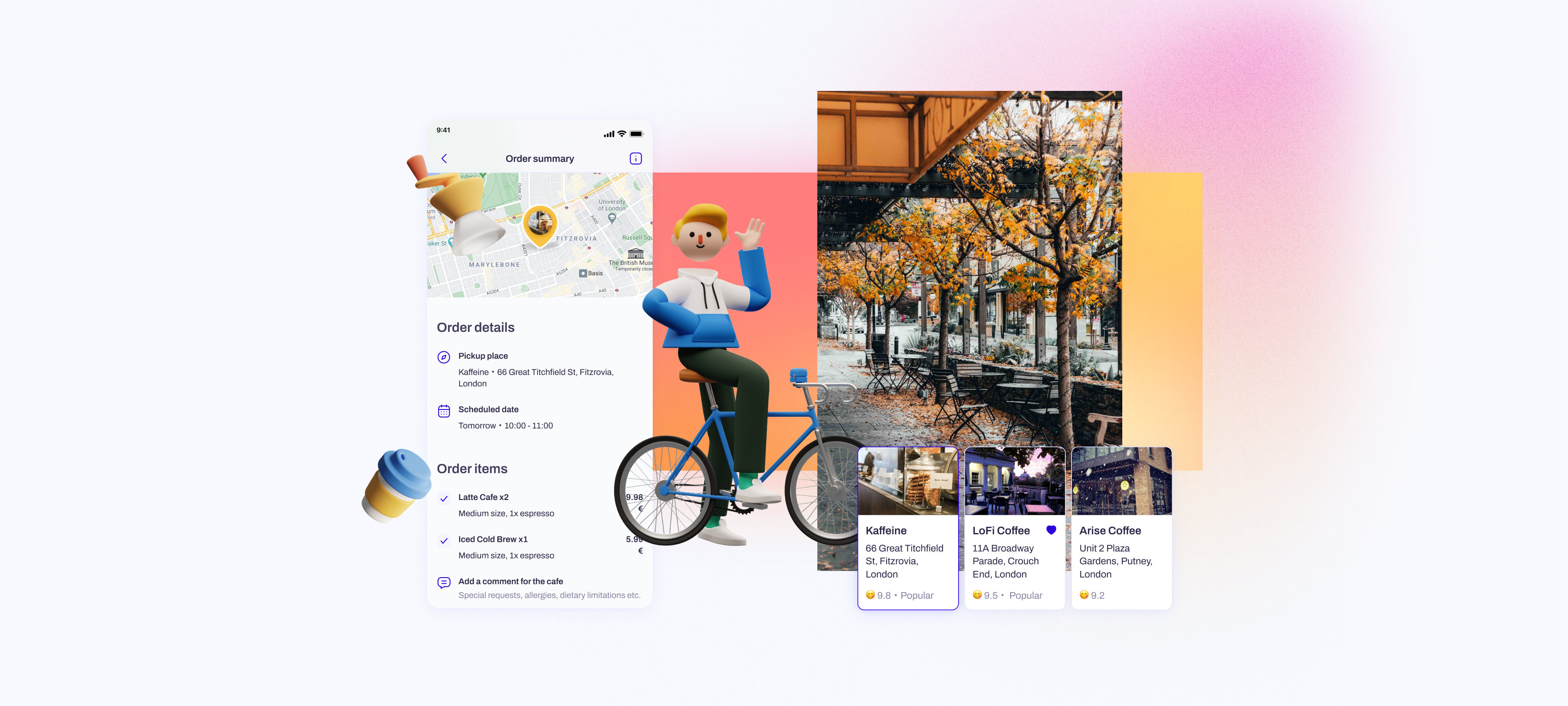
We started with familiar UX patterns from Wolt and Just Eat, but they didn't fit our unique requirements. Our UI blends clean shapes with a user-centric design: modern, intuitive, and built for fast, flexible ordering.
Warm Meets Cool. We chose a contrasting palette: orange and blue, inspired by autumn warmth. This pairing gives CafeCo a distinct visual personality.
Minimalism with a Spark. We kept things sleek and essential. Some elements use color to show their state, while others rely on bold typography. The base palette is white and gray, letting product photos shine. Shadows and blur effects give the overall look depth.
The Outcome
CafeCo came to life in just a few days. We're proud of what we accomplished as a two-person team, even if the UI took a little longer than planned.
Our biggest takeaway was to trust our instincts, test fast, and not overthink the process. It worked.
Building an app from idea to prototype in just three days is no small feat. Sure, the visuals took extra time, but the core concept was solid by the end of the weekend.
What's Next? Now that the pandemic's over, the idea isn't quite as groundbreaking. Still, there's potential to evolve it into a platform for users who want personalized orders, though it'd take serious effort. Maybe we'll revisit it someday.